Wednesday, December 25, 2024

Mastering the Machine Learning Pipeline: From Problem to Deployment


The Machine Learning Pipeline 

A Step-by-Step Guide to Building and Deploying Models

ML Pipeline

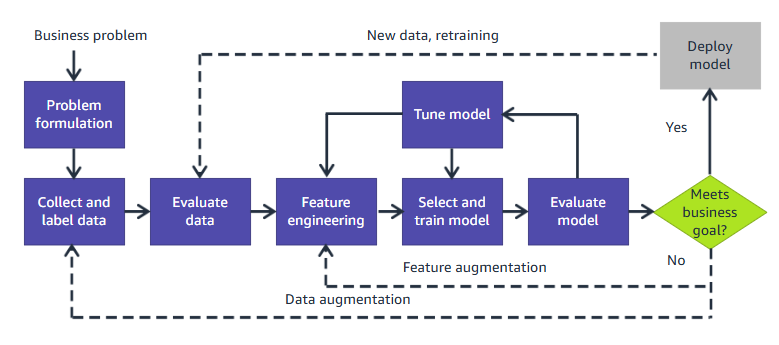
Machine learning (ML) has become an essential tool for solving complex business problems, enabling organizations to extract meaningful insights from data. The ML pipeline provides a structured approach to achieve this goal. In this article, we’ll break down each step in the ML pipeline to help you understand its components and practical implementation.

1. Problem Formulation: Defining the Goal

The journey begins with problem formulation, where the business problem is clearly defined. This step involves collaboration between business stakeholders and data scientists to answer questions such as:

  • What is the problem we are trying to solve?
  • What metrics will define success?
  • How will the solution impact business objectives?

For example, a business might want to predict customer churn, improve product recommendations, or optimize inventory management. This step transforms vague objectives into concrete, machine-learning-specific tasks like classification, regression, or clustering.

2. Collect and Label Data: Building the Foundation

Data is the backbone of machine learning. In this phase, you collect data from various sources such as databases, APIs, IoT devices, or web scraping. Key considerations include:

  • Data Volume: Ensure sufficient data for model training.
  • Data Quality: Address issues like missing values or inconsistent formats.
  • Data Relevance: Use data directly tied to the problem.

For supervised learning tasks, labeling data is critical. For example, if building a model to classify emails as spam or not, emails must be tagged as “spam” or “not spam” during this phase.

3. Evaluate Data: Assessing Data Quality

Once data is collected, it undergoes thorough evaluation. 

This step focuses on:

  • Identifying missing values, duplicates, or anomalies.
  • Analyzing data distribution to detect biases or imbalances.
  • Visualizing the data to uncover patterns or relationships.

Tools like Pandas, NumPy, and visualization libraries such as Matplotlib or Seaborn are often used for this purpose. If gaps are detected, corrective measures like data cleaning or augmentation are applied.

4. Feature Engineering: Preparing Data for Modeling

Raw data often needs transformation to unlock its potential. Feature engineering is the art of creating meaningful features from the data, which includes:

  • Feature Scaling: Normalize or standardize features to ensure equal treatment in models.
  • Feature Selection: Remove irrelevant or redundant features to improve model efficiency.
  • Data Augmentation: Generate synthetic data to enhance diversity (e.g., flipping or rotating images in computer vision).

For example, in a dataset of customer purchases, you might create a new feature like "average monthly spending" to help the model detect spending patterns.

5. Select and Train the Model: Building Intelligence

This step involves choosing an appropriate ML algorithm based on the problem type and dataset size. Common algorithms include:

The training process involves feeding the data into the selected model and optimizing it to minimize error. Modern ML frameworks like TensorFlow, PyTorch, and Scikit-learn make this step streamlined and efficient.

6. Evaluate the Model: Testing Performance

The trained model must be rigorously tested to ensure it performs well on unseen data. Key steps in model evaluation include:

If the model’s performance is inadequate, this feedback loop informs the need for further adjustments.

7. Tune the Model: Enhancing Accuracy

Model tuning involves fine-tuning hyperparameters to optimize performance. Techniques include:

  • Grid Search or Random Search: Explore different combinations of hyperparameters.
  • Cross-Validation: Test model stability across multiple data subsets.
  • Regularization: Prevent overfitting by penalizing overly complex models.

This phase is iterative, with adjustments made until the model achieves satisfactory results.

8. Meets Business Goals? Assessing Success

Once the model is evaluated and tuned, it’s time to validate its success against business goals. This step asks:

  • Does the model provide actionable insights?
  • Are the predictions accurate and reliable for real-world application?
  • Is the model aligned with the business’s key performance indicators (KPIs)?

If the answer is No, the pipeline loops back to earlier stages, such as data collection, feature engineering, or model selection, to refine the process.

9. Deploy the Model: Making It Operational

When the model meets business objectives, it’s ready for deployment. Deployment involves:

  • Integrating the model into a production environment (e.g., APIs, cloud platforms).
  • Setting up monitoring systems to track performance and detect drift.
  • Automating retraining with new data to keep the model relevant.

Popular tools like AWS SageMaker, Google AI Platform, and Azure ML facilitate smooth deployment and monitoring.

Continuous Iteration: The Never-Ending Cycle

Machine learning is a dynamic process. As business needs evolve and new data becomes available, the ML pipeline must adapt. Regular retraining, model updates, and performance reviews ensure the solution remains effective over time.

The ML pipeline provides a systematic approach to solving business problems using machine learning. By following these nine steps—problem formulation, data collection, data evaluation, feature engineering, model training, evaluation, tuning, deployment, and iteration—you can build robust, scalable models that deliver tangible business value.


Python Tools and Libraries for Machine Learning, NLP, Data Science & Web Scraping

Data Analytics with Python

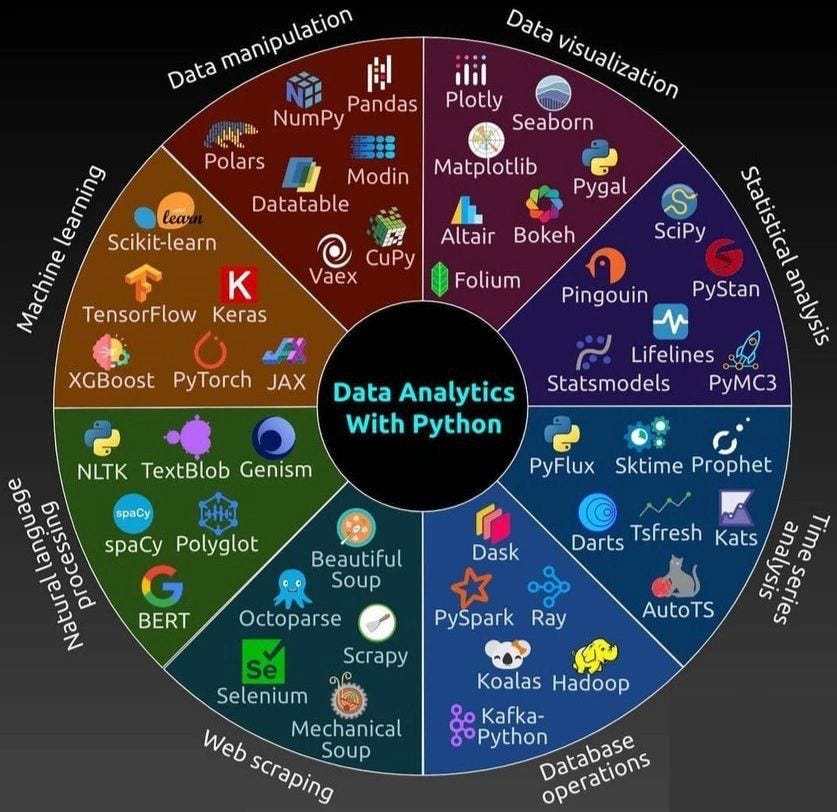
Exploring a range of Python tools used for data analytics, categorized by their applications.
Data Analytics with Python
Data Analytics with Python

Machine Learning

1. Scikit-learn: A versatile library providing simple and efficient tools for data mining and data analysis. It includes algorithms for classification (e.g., decision trees, k-NN), regression (e.g., linear regression, SVR), clustering (e.g., k-means, DBSCAN), and more. It also offers tools for data preprocessing, feature selection, and model evaluation.

2. TensorFlow: TensorFlow is an open-source machine learning framework developed by Google. It supports both deep learning and traditional machine learning tasks. TensorFlow is highly scalable, supports GPU acceleration, and is widely used for training large deep-learning models. TensorFlow 2.x integrates Keras for ease of use and improved performance.

3. Keras: Keras is a high-level API for building and training deep learning models, which works as an interface to TensorFlow. It simplifies the process of building neural networks by providing pre-built layers, optimizers, and loss functions. Keras is known for its simplicity and user-friendliness.

4. XGBoost: A popular implementation of gradient boosting, which is an ensemble technique used for regression, classification, and ranking tasks. XGBoost is highly efficient, handling large datasets and complex models with high performance. It supports distributed computing and is frequently used in data science competitions.

5. PyTorch: PyTorch is an open-source machine learning library, especially popular in academia. It provides dynamic computation graphs (which allows for flexible model development) and is known for its user-friendly interface. PyTorch is also highly optimized for GPU computing and supports deep learning tasks such as vision and NLP.

6. JAX: JAX is a numerical computing library developed by Google that offers automatic differentiation and GPU/TPU support. It provides a high-performance alternative to NumPy with features like just-in-time (JIT) compilation for faster execution and automatic differentiation for gradient-based optimization.

Natural Language Processing

1. NLTK: The Natural Language Toolkit (NLTK) is a leading platform for building Python programs that work with human language data. It offers easy-to-use interfaces to over 50 corpora and lexical resources, along with a wide range of text-processing libraries for tasks such as tokenization, stemming, tagging, and parsing.

2. TextBlob: TextBlob is a simpler NLP library that provides tools for common text processing tasks such as part-of-speech tagging, noun phrase extraction, sentiment analysis, and classification. It is built on top of NLTK and Pattern, providing a high-level API for working with text data.

3. Gensim: Gensim is an open-source library used for topic modeling, document similarity analysis, and natural language processing. It excels at handling large text corpora and offers models like Latent Dirichlet Allocation (LDA) and Word2Vec for word embeddings.

4. spaCy: spaCy is a fast and efficient library for advanced NLP tasks. It supports tokenization, part-of-speech tagging, named entity recognition, dependency parsing, and word vectors. spaCy is designed for production use and is highly optimized for performance.

5. PolyGlot: PolyGlot is a multi-purpose NLP pipeline supporting over 200 languages. It provides pre-trained models for tasks such as language detection, translation, and text classification, making it useful for global-scale NLP applications.

6. BERT: BERT (Bidirectional Encoder Representations from Transformers) is a state-of-the-art NLP model developed by Google. BERT uses a transformer architecture to understand the context of words in relation to all the other words in a sentence. It has revolutionized NLP by providing pre-trained models that can be fine-tuned for various tasks like question answering, sentence classification, and entity recognition.

Web Scraping

1. Octoparse: Octoparse is a no-code, visual web scraping tool that allows users to scrape data from websites without programming knowledge. It features a point-and-click interface, along with powerful features like automatic pagination handling and data export options.

2. Selenium: Selenium is an automation tool primarily used for web application testing, but it also works well for scraping dynamic websites. It simulates browser interactions, allowing you to scrape content rendered by JavaScript, which static tools like Beautiful Soup may not capture.

3. MechanicalSoup: MechanicalSoup is a Python library that automates interaction with websites using the requests and BeautifulSoup libraries. It’s useful for scraping simple websites and automating tasks such as form submission and login.

4. Scrapy: Scrapy is a fast, open-source web crawling and scraping framework for Python. It’s ideal for scraping large websites and processing vast amounts of data. Scrapy handles data extraction, cleaning, and exporting to various formats (CSV, JSON, etc.).

5. Beautiful Soup: Beautiful Soup is a Python library that helps you parse HTML and XML documents and extract data from them. It provides methods to search and navigate the parse tree, making it easy to extract content like text, links, and tables.

Data Manipulation

1. Polaris: Polaris is a Python tool that allows interactive data exploration with visualizations. It helps users quickly analyze large datasets by providing simple ways to explore data distributions and relationships.

2. NumPy: NumPy is a foundational package for scientific computing in Python, providing support for large, multi-dimensional arrays and matrices. It includes a powerful set of mathematical functions to manipulate these arrays and perform complex computations.

3. Pandas: Pandas is a widely-used library for data analysis and manipulation. It provides high-performance, easy-to-use data structures like DataFrame and Series. Pandas simplifies data cleaning, reshaping, merging, and aggregation tasks, making it essential for data preprocessing.

4. Modin: Modin is an optimization of Pandas, designed to scale processing across multiple cores or distributed environments. It allows you to run your existing Pandas code with minimal modifications but faster performance on large datasets.

5. Dask: Dask is a parallel computing library that extends the capabilities of NumPy, Pandas, and Scikit-learn. It is designed for working with large datasets that do not fit into memory by breaking them into smaller chunks and processing them in parallel.

6. Datatable: Datatable is a data manipulation library optimized for large datasets. It provides functionality similar to Pandas, but with performance improvements for out-of-core computations and parallel processing.

7. Vaex:Vaex is designed for efficient manipulation of large datasets by loading data lazily and performing computations in a memory-efficient manner. It is particularly useful for large tabular datasets that don’t fit into memory.

8. CuPy: CuPy is a library that enables NumPy-like array operations on NVIDIA GPUs, providing fast computation for large datasets, particularly useful in scientific computing and deep learning.

Data Visualization

1. Plotly: Plotly is an interactive graphing library that allows you to create web-ready plots. It supports various chart types, including line, bar, scatter, 3D plots, and geographical maps. Plotly is widely used for creating dashboards and publishing interactive reports.

2. Matplotlib: Matplotlib is a 2D plotting library for Python that enables you to create static, animated, and interactive visualizations. It is highly customizable and works well for simple plots like histograms, bar charts, and scatter plots.

3. Seaborn: Seaborn builds on top of Matplotlib and provides a higher-level interface for creating statistical visualizations. It includes several built-in themes and color palettes to make plots more aesthetically pleasing and informative.

4. Pygal: Pygal is a Python library for creating SVG (Scalable Vector Graphics) charts. It’s ideal for creating interactive and high-quality charts with a small footprint and easy-to-read syntax.

5. Altair: Altair is a declarative statistical visualization library, meaning you specify what data you want to visualize and how, while Altair handles the rest. It uses a grammar of graphics and integrates well with the Vega-Lite framework.

6. Bokeh: Bokeh is an interactive data visualization library that enables the creation of web-based visualizations. It’s suited for dashboards, streaming data, and complex plots with interactive elements like sliders, hover tools, and zooming.

7. Folium: Folium is a Python library for creating interactive maps using the Leaflet.js library. It is commonly used for visualizing geospatial data and plotting data points on maps, such as displaying the locations of events or geographical trends.

Statistical Analysis

1. SciPy: SciPy is built on top of NumPy and provides additional functionality for scientific and technical computing. It includes modules for optimization, integration, interpolation, eigenvalue problems, and more.

2. Pingouin: Pingouin is a lightweight library for statistical analysis, designed for simplicity and ease of use. It supports a variety of statistical tests, correlation coefficients, ANOVA, and more.

3. Statsmodels: Statsmodels is a library for statistical modeling that includes classes for linear and non-linear regression, time series analysis, hypothesis testing, and more. It’s particularly useful for econometrics and statistical research.

4. PyStan: PyStan is a Python interface to Stan, a powerful probabilistic programming language for statistical modeling. It allows you to create Bayesian models and fit them using Markov Chain Monte Carlo (MCMC) sampling.

5. PyMC3: PyMC3 is a library for probabilistic programming that enables users to build Bayesian models using MCMC or variational inference. It supports complex statistical modeling and is often used in data analysis and decision-making problems.

Time Series Analysis

1. PyFlux: PyFlux is a library for time series modeling and forecasting. It supports various models like ARIMA, GARCH, and others for both univariate and multivariate time series.

2. Sktime: Sktime is a library specifically for time series machine learning. It provides tools for classification, regression, and forecasting tasks, and supports model evaluation and hyperparameter tuning.

3. Prophet: Prophet is a forecasting tool developed by Facebook. It is particularly effective for forecasting data with strong seasonal patterns, and it includes features like automatic holiday effects.

4. Darts: Darts is a time series forecasting library that simplifies working with time series data and integrates machine learning models for forecasting tasks. It supports probabilistic forecasting and model evaluation.

5. TsFresh: TsFresh is a Python library for automatic extraction of relevant features from time series. It can help in feature engineering, which is a critical part of building time series prediction models.

6. AutoTS: AutoTS is an automated time series forecasting library. It simplifies the process of building forecasting models by automatically selecting the best model and tuning its parameters.

7. Kats: Kats is a toolkit developed by Facebook for time series analysis, including anomaly detection, forecasting, and seasonal decomposition. It is designed for ease of use and quick prototyping.

Database Operations

1. Koalas: Koalas is a library that brings the familiar Pandas API to Apache Spark. It allows users to perform data science operations on big data, seamlessly scaling from small datasets to large ones without needing to learn Spark’s syntax.

2. Kafka-Python: Kafka-Python is a Python client for Apache Kafka, a distributed streaming platform used for real-time data pipelines. It allows you to interact with Kafka for data streaming and message handling.

3. Hadoop: Hadoop is a widely used open-source framework for processing and storing large datasets in a distributed computing environment. It uses the MapReduce model for parallel data processing and HDFS (Hadoop Distributed File System) for data storage.

These tools cover a wide variety of applications in data science, machine learning, and data engineering, providing the functionality needed for everything from simple data manipulation to complex machine learning tasks. The specific choice of tool will depend on your project’s requirements, scale, and performance needs.

NotebookLM Your Ultimate AI-Powered Note-Taking Assistant


Google’s NotebookLM

The AI-Powered Research Assistant 

NotebookLM

Introduction

In today’s digital age, we’re constantly bombarded with information. It can be overwhelming to sift through all the data and find what we need. That’s where NotebookLM comes in. 

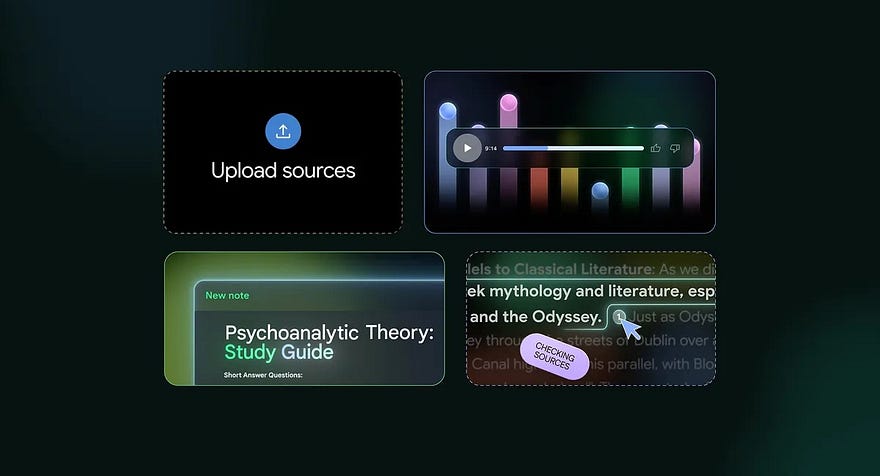
NotebookLM is an AI-powered research assistant developed by Google AI that helps you “understand and synthesize information” from various sources, making research and learning more efficient and insightful. 

What is NotebookLM?

NotebookLM

NotebookLM is more than just a note-taking app; it’s a powerful tool that leverages the capabilities of artificial intelligence to transform how we interact with information. 

It allows you to:

  • Organize and manage your research sources: Whether it’s documents, web pages, or audio files, NotebookLM provides a centralized platform to store and access all your research materials.
  • Engage in conversational AI-powered discussions: Ask questions, seek clarifications, and explore different perspectives through interactive dialogues with the AI.
  • Generate new content based on your sources: NotebookLM assists in creating various outputs, including study guides, briefing documents, and even audio overviews.

Key Features and Use Cases

NotebookLM

1. A New, Intuitive Interface 

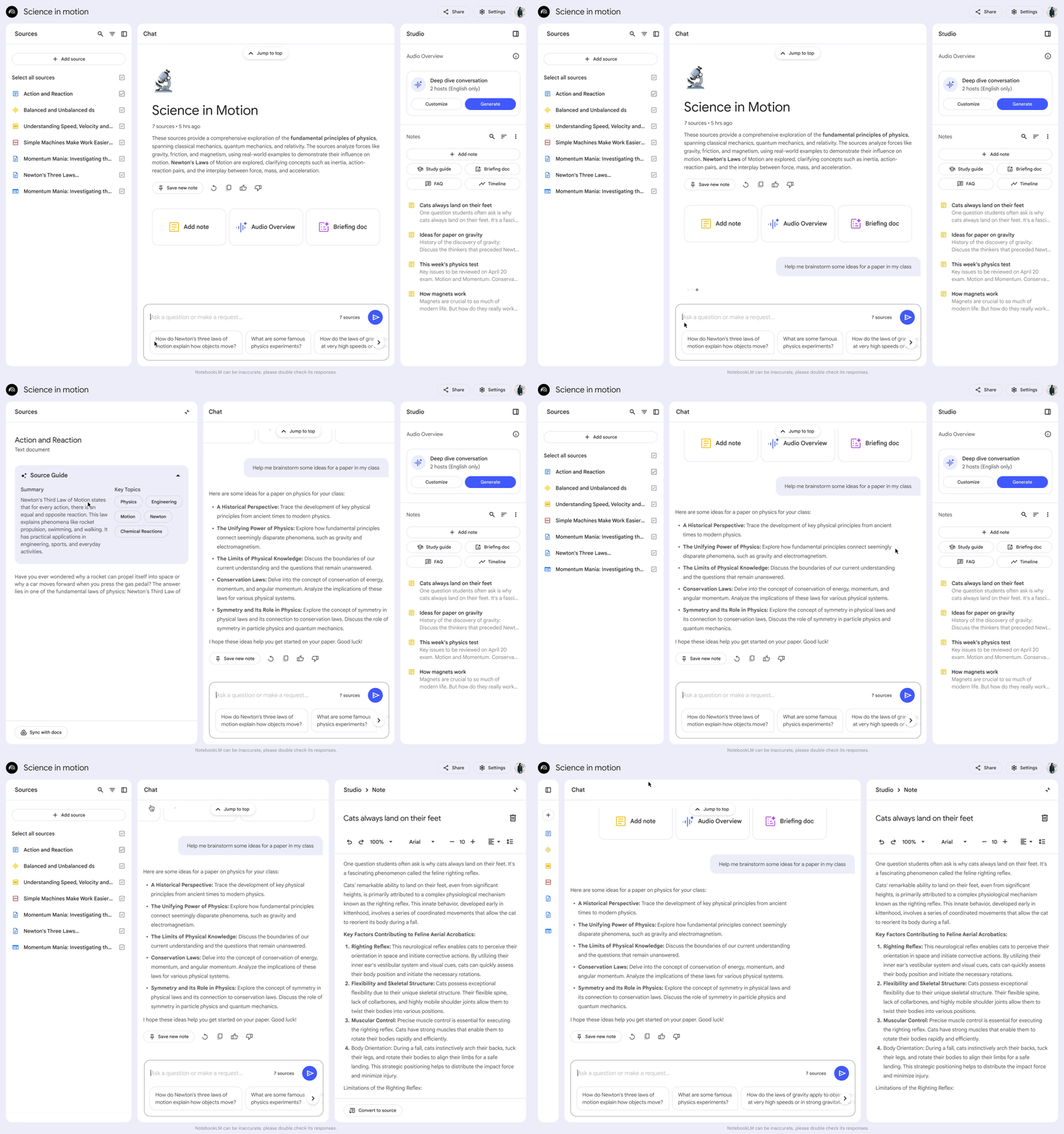
NotebookLM features a redesigned interface divided into three key areas:

  • Sources Panel: Enables efficient management of all your research materials. 
  • Chat Panel: Facilitates conversational interaction with the AI, complete with citations for transparency.
  • Studio Panel: Streamlines the creation of new content from your sources. 

This design allows for seamless transitions between tasks, such as expanding the source viewer for note-taking or asking questions during an audio overview.

2. Interactive Audio Overviews

NotebookLM Audio Overview 


A standout feature is the ability to "join" audio overviews and engage with the AI hosts. This interactive mode allows you to: 

  • Ask for more details or explanations.
  • Receive personalized responses based on your sources. 

It's like having a personal tutor who guides you through the information.

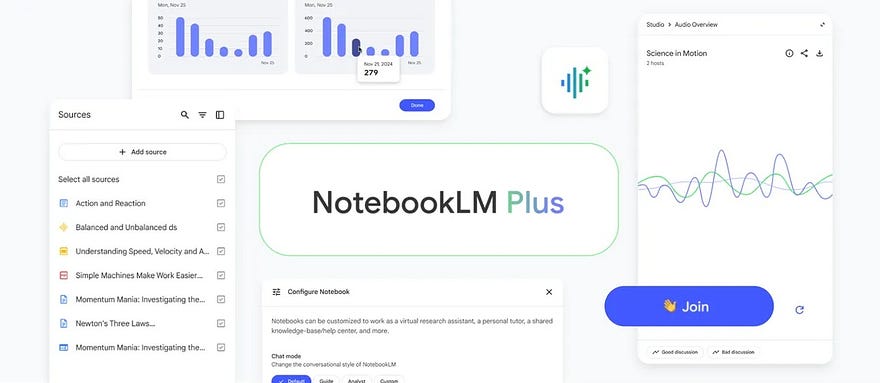
3. NotebookLM Plus: Enhanced Capabilities

NotebookLM Plus

For power users, teams, and enterprises, NotebookLM Plus offers a premium subscription with additional features and benefits:

  1. Higher Usage Limits: More than five times the capacity for audio overviews, notebooks, and sources.
  2. Customization: Ability to tailor the style and length of notebook responses.
  3. Team Collaboration: Shared notebooks with usage analytics for enhanced teamwork.
  4. Enhanced Privacy and Security: Enterprise-grade protection for sensitive information. 

NotebookLM Plus is available through Google Workspace, Google Cloud, and will be included in Google One AI Premium.

Technology Behind NotebookLM

Technology powering NotebookLM, is built upon “Advanced natural language processing (NLP) models and machine learning algorithms” developed by Google AI. Google has roll out the experimental version of Gemini 2.0 Flash in NotebookLM. 

These technologies allow the tool to:

  • Understand and interpret text and audio data.
  • Extract key insights and generate summaries.
  • Engage in human-like conversations.

NotebookLM's capabilities suggest the involvement of large language models (LLMs) similar to those used in other Google AI products. 

Benefits of Using NotebookLM

Enhanced Research Efficiency: NotebookLM streamlines research by organizing sources, providing AI-powered insights, and simplifying content creation. 
Deeper Understanding: Interactive features like the chat panel and audio overviews promote active engagement with the material, leading to better comprehension.
Improved Productivity: By automating tasks like summarization and content generation, NotebookLM frees up time for more critical thinking and analysis. 

Future Prospects

NotebookLM is poised to become an indispensable tool for researchers, students, and professionals across various fields. As AI technology continues to advance, we can anticipate further enhancements to NotebookLM’s capabilities, including:

  • More sophisticated AI interactions: The ability to engage in even more nuanced and context-aware conversations with the AI. 
  • Integration with other tools and platforms: Seamless connections with other productivity and research applications. 
  • Personalized Learning Experiences: Tailored recommendations and insights based on individual learning styles and preferences. 
NotebookLM is revolutionizing the way we learn, work, and interact with information. By harnessing the power of AI, it empowers us to overcome information overload, gain deeper insights, and unlock our full intellectual potential.  

As NotebookLM continues to evolve, it promises to play an increasingly vital role in shaping the future of research and learning. 

Sunday, December 22, 2024

AI Advancements: Phi-4, Hunyuan, Gemini 2.0


AI Breakthroughs: Pioneering Models Reshape the Future

AI Advancements: Phi-4, Hunyuan, Gemini 2.0 

Let’s Explore the ground-breaking advancements in AI, focusing on Phi-4’s exceptional performance, HunyuanVideo’s open-source video generation, and Gemini 2.0 Flash’s multimodal capabilities.

The AI realm is abuzz with groundbreaking innovations, and the latest advancements in language models, video synthesis, and multimodal AI are leading the charge. This article explores the transformative potential of these cutting-edge models and their implications for the future.

Phi-4: Small Size, Giant Strides

Microsoft Phi-4

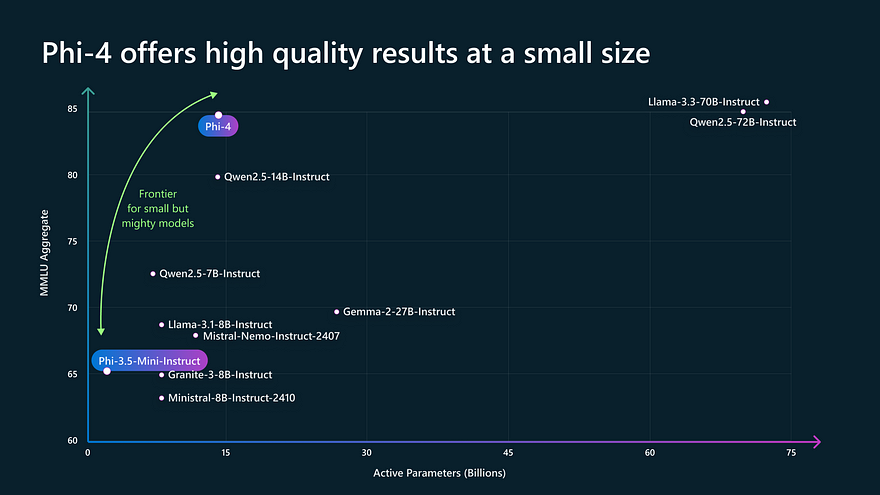
Microsoft's Phi-4, a language model with a mere 14 billion parameters, has shattered expectations by surpassing models five times its size in performance. This remarkable feat underscores the critical role of high-quality training data in AI model development.

Key Feature :-

  • Unmatched Performance: Phi-4 outshines larger models like Llama 3.3 70B and Qwen 2.5 on complex math and reasoning benchmarks, demonstrating that size isn’t the sole determinant of AI prowess. 
  • Data Curation Mastery: The secret behind Phi-4’s success lies in its meticulously curated training data, comprising high-quality web data and advanced techniques like GPT-4o rewriting and Direct Preference Optimization (DPO). 
  • Open Access for Innovation: Phi-4’s availability on Azure AI Foundry and Hugging Face under a non-commercial license democratizes AI research, enabling a wider community to contribute to its development and applications.

HunyuanVideo: Democratizing Video Generation

HunyuanVideo


Tencent's HunyuanVideo marks a significant breakthrough in open-source video generation, rivaling the performance of closed commercial models. This development has the potential to revolutionize video content creation and research.

Key Features :-

  • Commercial-Grade Performance: HunyuanVideo’s video generation capabilities are on par with closed commercial models, as validated by human evaluation, showcasing the potential of open-source AI models.
  • Open-Source Empowerment: The model’s open code and open weights provide researchers and developers with unprecedented access to advanced video generation technology, fostering innovation and collaboration.
  • Architectural Ingenuity: HunyuanVideo’s sophisticated architecture, featuring a convolutional video encoder-decoder, text encoders, a time-step encoder, and a transformer, trained in stages using advanced techniques, exemplifies the state-of-the-art in video generation.

Gemini 2.0 Flash


Gemini 2.0 Flash: Multimodal Maestro

Google's Gemini 2.0 Flash represents a monumental leap in multimodal modeling. Its ability to process a staggering 2 million tokens of input context and generate text, images, and speech opens doors to a plethora of AI applications.

Key Features

  • Multimodal Powerhouse: Gemini 2.0 Flash seamlessly handles text, images, video, and speech, making it a versatile tool for diverse AI tasks, from content creation to real-time translation. 
  • Blazing Speed and Performance: The model’s impressive speed and superior performance compared to its predecessor, Gemini 1.5 Pro, on various benchmarks highlight the rapid pace of AI development.
  • Real-Time API: The Multimodal Live API empowers real-time applications like live translation and video recognition, demonstrating the potential of AI to enhance user experiences. 
  • AI Agents: Google’s introduction of four agents, including Astra, Mariner, and Deep Research, leveraging Gemini 2.0 Flash’s capabilities, showcases the potential of AI to automate complex tasks and augment human productivity.

The Road Ahead: AI’s Promising Future

These revolutionary models are not just isolated breakthroughs; they represent a paradigm shift in the AI landscape. As AI models become increasingly sophisticated, accessible, and multimodal, we can expect to see a wave of transformative applications across industries. 
The rapid advancements in AI, as exemplified by models like Phi-4, HunyuanVideo, and Gemini 2.0 Flash, have set the stage for an AI-powered future. 

By embracing these innovations and fostering responsible AI development, we can unlock new possibilities and shape a future where AI augments human potential and drives progress. 

Machine Learning Algorithms


An Overview of Machine Learning Algorithms

A Must-Know for Data Scientists

Machine Learning Algorithms
 

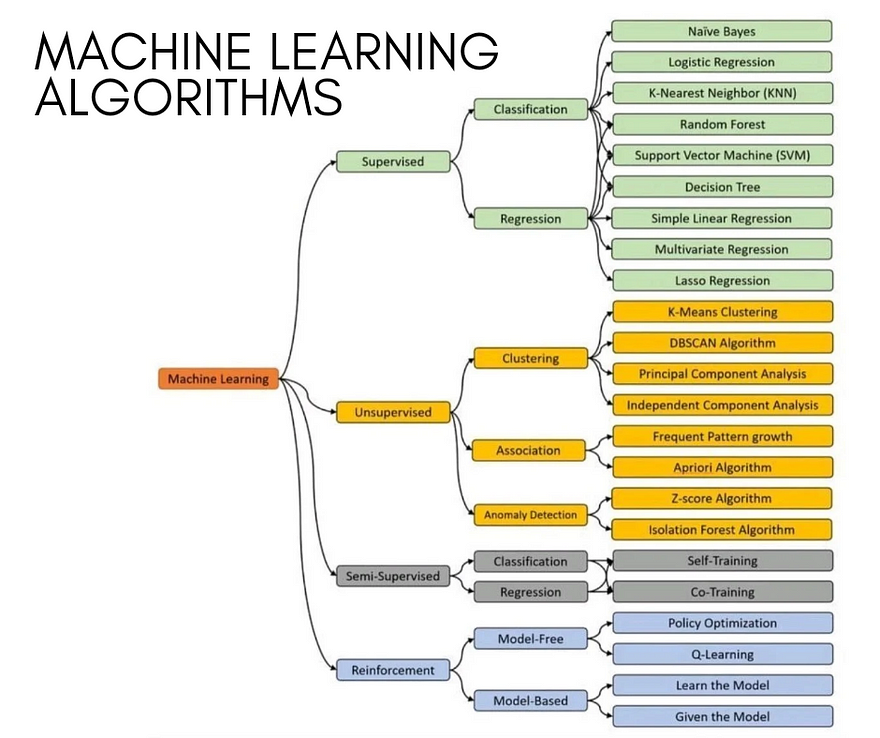
Machine Learning (ML) is a branch of artificial intelligence (AI) that focuses on building systems capable of learning and improving from experience. For data scientists, understanding the wide array of machine learning algorithms is crucial for applying the right solutions to data-driven problems. 

Algorithms can be categorized into Supervised Learning, Unsupervised Learning, Semi-Supervised Learning, and Reinforcement Learning. Let’s dive into the key details of each category and their respective algorithms.

1. Supervised Learning

Supervised learning algorithms learn from labeled datasets, meaning each data point is paired with the correct output. The main tasks include Classification and Regression.

Classification

Classification algorithms are used to predict categorical outputs (e.g., spam vs. not spam). Key algorithms include:

1. Naive Bayes: Based on Bayes' theorem, this algorithm assumes feature independence. It's commonly used in text classification.
2. Logistic Regression: A statistical method for binary classification problems.
3. K-Nearest Neighbor (KNN): Classifies a data point based on its proximity to other labeled data points.
4. Random Forest: A decision tree-based ensemble method that improves accuracy by averaging results from multiple trees.
5. Support Vector Machine (SVM): Finds the hyperplane that best separates data into classes.
6. Decision Tree: A tree-like model for making decisions, splitting data based on feature importance.

Regression

Regression models predict continuous outputs (e.g., house prices). Algorithms include:

1. Simple Linear Regression: Finds a linear relationship between two variables.
2. Multivariate Regression: Handles multiple independent variables.
3. Lasso Regression: Adds regularization to minimize overfitting.

2. Unsupervised Learning

Unlike supervised learning, unsupervised learning deals with unlabeled data, discovering hidden patterns or structures. It is primarily used for Clustering, Association, and Anomaly Detection.

Clustering

Clustering groups data points based on similarity. Popular algorithms include:

1. K-Means Clustering: Partitions data into k clusters by minimizing the distance between points and their cluster centroid.
2. DBSCAN (Density-Based Spatial Clustering of Applications with Noise): Groups points based on density and identifies outliers.
3. Principal Component Analysis (PCA): Reduces data dimensionality by identifying key features.
4. Independent Component Analysis (ICA): Similar to PCA but focuses on statistical independence between components.

Association

Association algorithms discover relationships between variables in large datasets:

1. Frequent Pattern Growth: A method to mine frequent itemsets efficiently.
2. Apriori Algorithm: Commonly used in market basket analysis to identify rules like "If a customer buys X, they are likely to buy Y."

Anomaly Detection

These algorithms detect unusual patterns or outliers:

1. Z-Score Algorithm: Identifies anomalies by measuring the standard deviations away from the mean.
2. Isolation Forest: An ensemble-based method to isolate anomalies effectively.

Semi-Supervised Learning

Semi-supervised learning uses a mix of labeled and unlabeled data, making it useful for scenarios where labeling data is expensive or time-consuming.

Classification

Self-Training: Initially trains a model with labeled data, then uses predictions on unlabeled data to retrain.

Regression

Co-Training: Trains multiple models on different views of the same data to improve performance.

Reinforcement Learning

Reinforcement learning focuses on training agents to make decisions by interacting with an environment, aiming to maximize cumulative rewards. It is categorized into Model-Free and Model-Based approaches.

Model-Free

1. Policy Optimization: Improves decision-making policies directly.

2. Q-Learning: Learns the value of actions to maximize future rewards.

Model-Based

1. Learn the Model: Develop a model of the environment for planning.
2. Given the Model: Uses a pre-defined model for decision-making.

How to Choose the Right Algorithm?

The choice of an algorithm depends on:

1. Data type: Labeled or unlabeled data.
2. Goal: Classification, regression, clustering, or anomaly detection.
3. Complexity: Some algorithms, like Random Forest, are more computationally intensive.
4. Interpretability: Simple models like Logistic Regression are easier to explain compared to Neural Networks.

Machine learning offers a diverse toolkit for solving complex problems. Understanding these algorithms' strengths, weaknesses, and applications is essential for data scientists to build robust and efficient models. 

Mastering this hierarchy of algorithms equips you to handle various challenges, from predicting customer behavior to uncovering hidden insights in data.


Thursday, December 19, 2024

Nvidia’s Generative AI Supercomputer “Jetson Orin Nano Super Developer Kit "

Nvidia’s Generative AI Supercomputer

Nvidia’s “Jetson Orin Nano Super Developer Kit” represents a significant advancement in edge computing technology, designed to empower developers and hobbyists with generative AI capabilities.

Key Features 

The Jetson Orin Nano Super is a compact developer kit that packs impressive specifications:

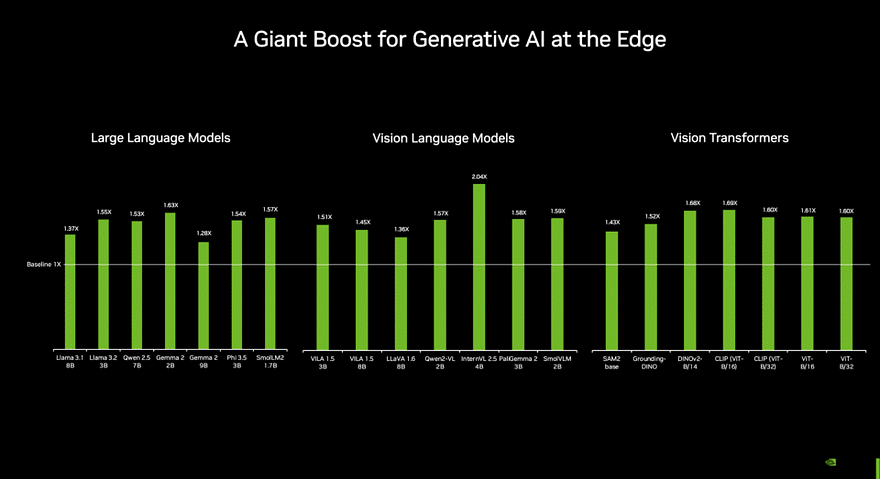
  • Performance: Offers 67 TOPS (trillions of operations per second) for generative AI workloads, a substantial increase from its predecessor’s 40 TOPS.
  • Memory Bandwidth: Enhanced memory bandwidth of 102 GB/s, facilitating faster data processing.
  • Architecture: Equipped with an NVIDIA Ampere architecture GPU, featuring 1024 CUDA cores and a six-core Arm Cortex-A78AE CPU.
  • Power Efficiency: Operates at just 25 watts, making it suitable for battery-powered applications.
  • Connectivity: Includes multiple I/O options such as two camera connectors, four USB 3.2 ports, and Gigabit Ethernet.

Technological Advancements

The Jetson Orin Nano Super integrates cutting-edge technology that enhances its performance:

  • AI Model Support: Capable of running various generative AI models including large language models (LLMs), vision language models (VLMs), and vision transformers (ViTs).
  • Software Ecosystem: Supports the NVIDIA AI software stack, allowing developers to utilize frameworks like TensorRT and CUDA for optimized performance.
  • Community Support: Backed by a robust community and extensive resources, including tutorials and project inspirations from the NVIDIA Jetson AI lab.

Applications Across Industries

The versatility of the Jetson Orin Nano Super makes it applicable in numerous fields:

|| Robotics: Ideal for developing smart robots capable of complex tasks through enhanced AI reasoning.
|| Healthcare: Facilitates the creation of AI-powered devices for diagnostics and patient monitoring.
|| Smart Surveillance: Enhances security systems with real-time video analytics.
|| Autonomous Vehicles: Supports the development of intelligent navigation systems.
|| Education and Research: Provides an accessible platform for students and researchers to experiment with AI technologies.

Future Prospects

As generative AI continues to evolve, the Jetson Orin Nano Super positions itself as a key player in democratizing access to powerful computing resources. Its affordability priced at just $249 opens doors for innovation among startups, educational institutions, and individual developers. 

With ongoing software updates enhancing performance even for existing users, the future looks bright for this compact supercomputer. As industries increasingly adopt AI solutions, the Jetson Orin Nano Super is set to play a pivotal role in shaping the next generation of intelligent applications.

Nvidia’s Jetson Orin Nano Super Developer Kit exemplifies how compact technology can drive significant advancements in generative AI. With its powerful features, broad application potential, and supportive ecosystem, it stands as an essential tool for developers looking to harness the power of artificial intelligence in innovative ways.

How to Get £7,000/Year with the Newcastle University Vice-Chancellor’s Scholarship 2027

Newcastle University Vice-Chancellor’s International Scholarship 2027: Complete Overview, Eligibility & Application Guide Newcast...