Tuesday, December 17, 2024

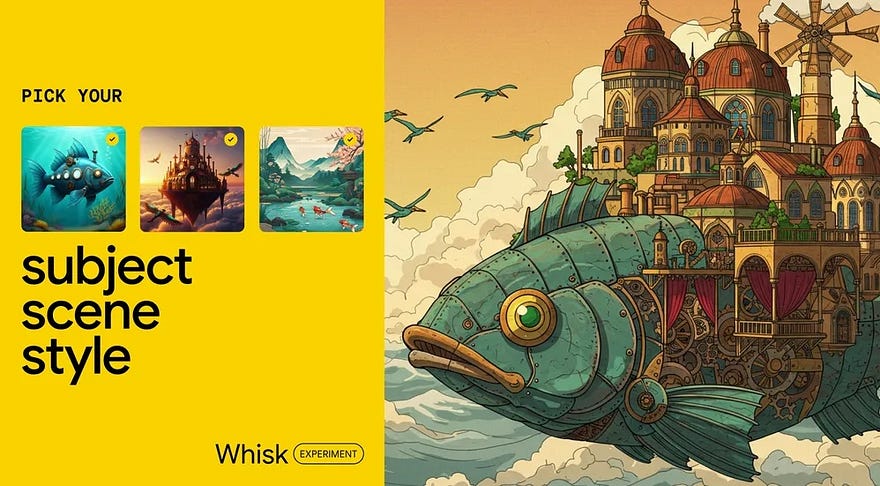
Introducing Whisk: Google’s New AI Tool for Image-Based Creative Design

Whisk by Google Labs

A New Experiment for Fast and Fun Image-Prompted Creativity

Whisk by Google

In the rapidly evolving landscape of artificial intelligence, Google has introduced Whisk, a cutting-edge AI tool that transforms the way users create images. By allowing users to generate visuals based on existing images rather than solely relying on text prompts. 

Whisk marks a significant leap in generative art technology. 

Understanding Whisk: The Technology Behind It

The AI Models

Whisk is powered by two advanced AI models:

  1. Gemini: This model plays a crucial role in interpreting the uploaded images. It generates detailed captions that describe the visual elements present in the images, which serve as prompts for further image generation.
  2. Imagen 3: This model takes the captions produced by Gemini and uses them to create new images. Imagen 3 is designed to understand artistic styles and contextual elements, enabling it to generate unique outputs that capture the essence of the input images while introducing creative variations.

How Whisk Functions


The process of using Whisk is straightforward and user-friendly:

  • Image Upload: Users can easily drag and drop images into the Whisk interface. These images can represent various subjects, scenes, or artistic styles.
  • Caption Generation: Once an image is uploaded, Gemini analyzes it and generates a descriptive caption that encapsulates its content. This caption serves as a foundation for the next step.
  • Image Generation: Using the generated caption, Imagen 3 creates new images that are inspired by the original but not limited to it. This generative remixing allows for a wide range of creative possibilities.
  • Refinement Options: Users have the option to tweak the generated outputs by modifying the underlying prompts or adjusting parameters, providing flexibility in achieving desired results.

Key Features of Whisk

Whisk boasts several standout features that enhance its usability and appeal
:
  • Visual Prompts
    Unlike traditional image generation tools that rely heavily on text prompts, Whisk’s use of visual inputs streamlines the creative process. This feature is particularly advantageous for users who may struggle with articulating their ideas in words.
  • Creative Exploration
    Whisk encourages users to experiment and brainstorm visually. The ability to quickly generate multiple variations based on a single image fosters an environment where creativity can flourish without constraints.
  • Collaborative Tools
    Whisk is designed with collaboration in mind. Users can easily share generated images with team members or clients for feedback, making it an excellent tool for collaborative projects in design and marketing.
  • High-Quality Outputs
    Thanks to the sophisticated algorithms behind Gemini and Imagen 3, Whisk produces high-resolution images that maintain artistic integrity and detail. This quality makes it suitable for professional use in various fields.

Applications of Whisk

The versatility of Whisk opens up numerous applications across different industries:

For Artists and Designers

  • Concept Development: Artists can use Whisk to quickly visualize concepts and explore different styles without starting from scratch.
  • Mood Boards: Designers can create mood boards by generating variations based on specific themes or color palettes.

For Marketing Professionals

  • Campaign Visuals: Marketers can generate unique visuals tailored to specific campaigns or target audiences without extensive graphic design skills.
  • Social Media Content: With the ability to produce engaging images rapidly, marketers can keep their content fresh and appealing across platforms.

For Content Creators

  • Blog Imagery: Bloggers can generate eye-catching images to accompany their posts, enhancing visual appeal and engagement.
  • Video Thumbnails: Content creators can produce compelling thumbnails that attract viewers’ attention on platforms like YouTube.

Benefits of Using Whisk

  • Time Efficiency
    By reducing the time spent on brainstorming and creating visuals from scratch, Whisk allows users to focus more on refining their ideas and executing their projects.
  • Accessibility
    Whisk democratizes image creation by making it accessible to individuals without extensive design backgrounds. This opens up opportunities for creativity across various skill levels.
  • Innovation in Creativity
    With its unique approach to image generation, Whisk encourages innovative thinking. Users are prompted to explore new styles and concepts they might not have considered otherwise.
Google’s Whisk AI tool represents a significant advancement in generative art technology by emphasizing visual inputs over traditional text prompts. Its user-friendly interface, powerful AI models, and diverse applications make it an essential tool for professionals in art, design, marketing, and content creation.

As this technology continues to evolve, it promises to further enhance how we approach image generation and creative expression, paving the way for new artistic possibilities and innovative solutions across industries.

By embracing tools like Whisk, creators can harness the power of AI to elevate their work, streamline their processes, and unleash their full creative potential.

As we look toward the future of digital creativity, tools like Whisk will undoubtedly play a pivotal role in shaping how we visualize our ideas.


Sunday, December 15, 2024

Artificial Intelligence What It Is, What It Isn’t, and Why It Matters


Unraveling the Enigma of Artificial Intelligence

What It Is, What It Isn’t, and Why It Matters

Artificial intelligence
Let’s Decoding the Buzzword "AI"
Artificial intelligence (AI) is everywhere it’s a buzzword that permeates our daily lives. It dominates headlines, fuels technological advancements, and even sparks philosophical debates. But what exactly is AI? And why is it so challenging to define? 

Let's embark on a journey to explore the intricate world of AI, dissecting its definition, applications, and implications.

AI in Action: A Glimpse into Its Transformative Power


Before diving into the complexities of defining AI, let's examine how it manifests in real-world scenarios. Here are three captivating applications that highlight different facets of AI:
  1. Self-Driving Cars: These engineering marvels rely on an intricate interplay of AI techniques. Search and planning algorithms determine optimal routes, computer vision systems identify obstacles and decision-making capabilities navigate the complexities of dynamic environments. The potential implications are vast, encompassing improved road safety, enhanced logistics efficiency, and a shift in human roles toward supervision.
  2. Content Recommendation: From personalized social media feeds to tailored online advertisements, AI algorithms curate the information we encounter daily. These algorithms analyze our preferences and behaviors to deliver content we will likely engage with. This raises concerns about potential filter bubbles, echo chambers, and the spread of misinformation.

Image and Video Processing:

AI-powered facial recognition is already commonplace in various applications, from photo organization to passport control. Similar techniques enable autonomous cars to perceive their surroundings and estimate wildlife populations. Furthermore, AI can generate and manipulate visual content, blurring the lines between reality and fabrication. This raises critical questions about the authenticity of visual media.

The Elusive Definition of AI: Unpacking the Complexity

Despite its pervasiveness, defining AI remains a perplexing endeavor. The term often encompasses diverse concepts and technologies, leading to ambiguity and confusion. Here are three key reasons why:

  1. No Universally Agreed Definition: Even within the AI research community, a precise definition remains elusive. The field is continuously evolving, with some topics reclassified as non-AI while new ones emerge. A humorous yet insightful definition suggests that AI comprises "cool things that computers can’t do." This implies that as soon as a task becomes achievable by computers, it ceases to be an AI problem.
  2. The Influence of Science Fiction: The portrayal of AI in science fiction further complicates its understanding. Fictional representations often depict humanoid robots with human-like intelligence, sometimes exceeding human capabilities. While these portrayals serve as metaphors for the human condition, they contribute to unrealistic expectations and misconceptions about AI.
  3. The Paradox of Perception: Tasks that humans find effortless, such as grasping objects, prove remarkably challenging for robots. Conversely, tasks perceived as complex, like playing chess, can be readily solved by computers. This discrepancy highlights the difficulty in discerning the true complexity of AI tasks.

Towards a More Meaningful Definition: Embracing Autonomy and Adaptability

Moving beyond simplistic definitions, a more useful approach is to identify key characteristics of AI. Two prominent attributes are:

Artificial intelligence 
  1. Autonomy: The ability of AI systems to operate in complex environments without constant human intervention.
  2. Adaptivity: The capacity of AI systems to enhance their performance through learning from experience.

However, even these terms can be misleading. Assigning human-like qualities like "understanding" or "intelligence" to AI systems can create false impressions about their capabilities.

Navigating the Nuances of AI Terminology: Avoiding "Suitcase Words"

To avoid misinterpretations, it's crucial to recognize that terms like "learning," "understanding," and "intelligence" carry multiple meanings. Marvin Minsky, a renowned cognitive scientist, coined the term "suitcase words" for such terms. These words encompass a range of meanings, increasing the risk of miscommunication.

Embracing the Spectrum of "AIness": A Multifaceted Discipline

Rather than rigidly categorizing something as AI or non-AI, it's more appropriate to consider a spectrum of "AIness." Some methods clearly fall within the realm of AI, while others exhibit only a "pinch of AI."  It's crucial to remember that AI is not a single entity but a scientific discipline encompassing concepts, problems, and solution methods. 

Furthermore, it's more accurate to refer to "an AI method" rather than "an AI," aligning with the understanding of AI as a scientific discipline. Headlines and discussions should accurately reflect the capabilities of AI systems and avoid misleading claims.

Embracing the Future with a Balanced Perspective

AI is a rapidly evolving field with transformative potential across various domains. While defining it precisely remains a challenge, understanding its core characteristics and navigating the nuances of its terminology is essential. As AI continues to permeate our lives, a balanced perspective that acknowledges both its possibilities and limitations is paramount. By demystifying the enigma of AI, we can better harness its power for the betterment of society.

Friday, December 13, 2024

Grok's Image Generation Model for 𝕏 platform


Grok’s Autoregressive Image Generation Model

The Next Generation of AI Image Creation 

Grok's image generation model 

Grok, the innovative AI tool developed by xAI, is revolutionizing the world of image generation. With its latest update, code-named “Aurora”. 
Grok has taken a giant leap forward, introducing an autoregressive image generation model that surpasses existing capabilities. 

Let’s delve into the cutting-edge technology behind Grok, explore its remarkable features, compare it to other prominent AI image-generation tools, and discuss its potential future impact. 

Technology Behind Grok

Aurora, the driving force behind Grok’s enhanced image generation abilities, is an “autoregressive mixture-of-experts network”. This sophisticated model is trained to predict the next token from a blend of text and image data, leveraging billions of examples from the vast expanse of the internet. This extensive training has endowed Aurora with a deep understanding of the world, enabling it to excel in photorealistic rendering and faithfully following intricate text instructions. Furthermore, Aurora boasts native support for multimodal input, empowering it to draw inspiration from or directly modify user-provided images.

Features of Grok 

Grok offers an impressive array of features, setting it apart from other image-generation tools:

  • Photorealistic Rendering:
        Grok’s ability to generate highly realistic images, including human portraits, sets a new         standard in image quality.

Jackie Chan in Donald Trump’s hairstyle
  • Precise Detailing: The model excels at rendering precise visual details, including text, logos, and real-world entities, overcoming challenges often faced by other models.
A comic of a young man standing by the sea, looking back and saying "Make it happen Yesterday"

Generate a creative logo for "GROK" with a golden color and sunglasses

    Lockheed SR-71 Blackbird in an abstract style

    Elon Musk as a Ghibli character

    Multimodal Input: Grok’s ability to process both text and images as input provides users with unparalleled creative control and flexibility.
    Cherry Blossom 

    A superposition of a cat in a hyperbolic time chamber in the style of Van Gogh

    An origami Cybertruck

    Dog drinking a tea

    A rock hyrax

    Crude crayon drawing of a Tesla driving through a fiery meadow
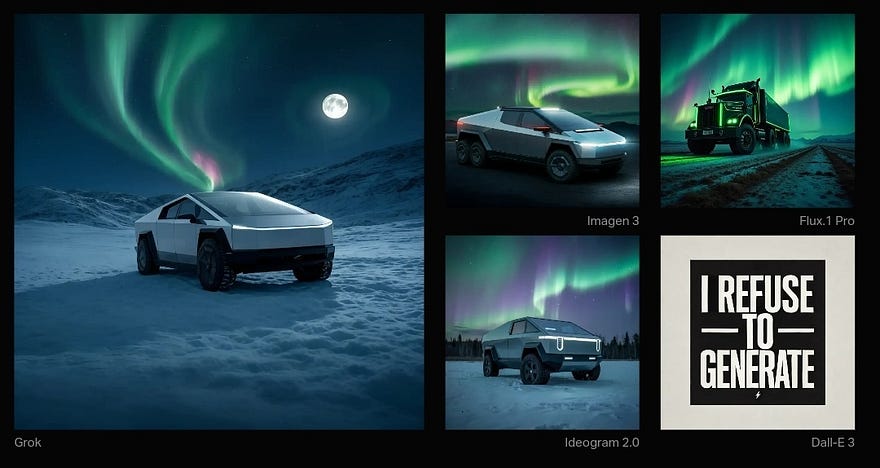
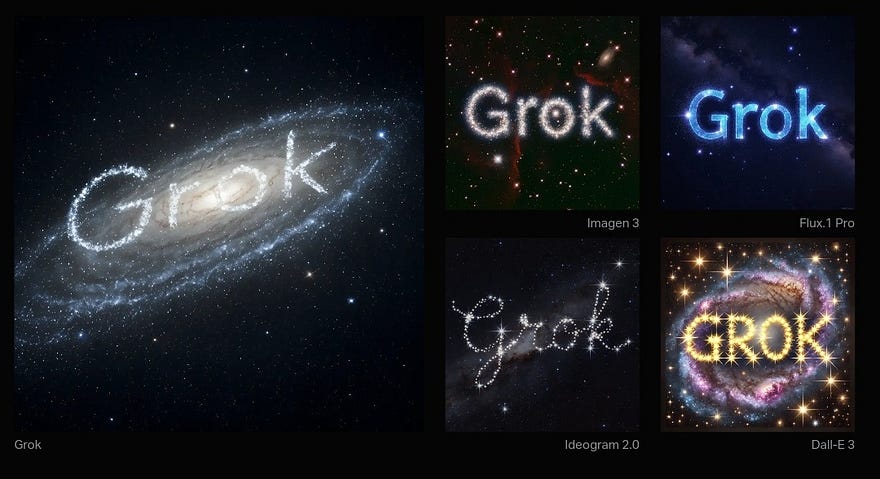
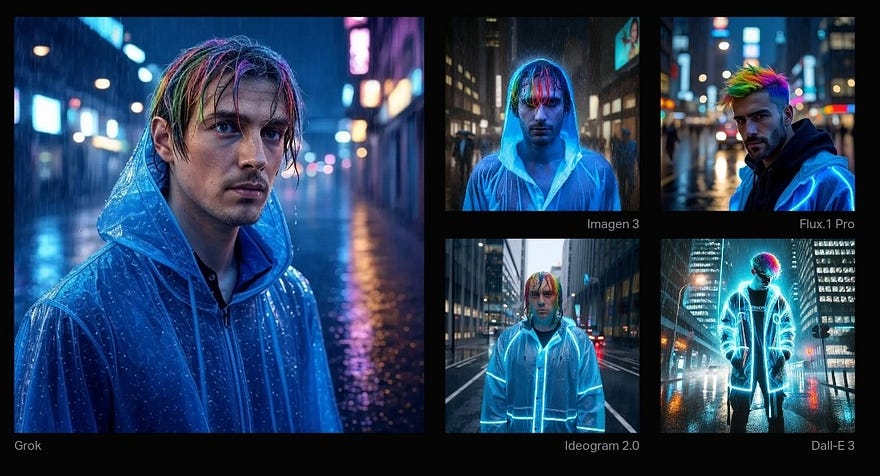
      Grok vs. Other AI Image Generation Tools

      While several AI image-generation tools exist, Grok stands out for its advanced capabilities and performance. 

      Examples of these include: 

      Prompt: Cybertruck under an aurora


      Prompt: Stars in a galaxy spelling "Grok"


      Prompt: Elon Musk wearing an xAI jacket with a USA flag in the background


      Prompt : A man with wet rainbow hair and a neon blue raincoat standing in heavy rain on the city street.


      Implementation and Availability 

      Grok’s new image generation capabilities are currently being rolled out on the 𝕏 platform, with availability expanding to all users within a week. This widespread accessibility will democratize cutting-edge image generation technology, empowering a broad user base with creative tools.

      Future Prospects

      The developers at xAI are committed to pushing the boundaries of multimodal understanding and generation. As Grok continues to evolve, we can anticipate even more sophisticated features, enhanced accuracy, and broader applications across various fields. 

      The potential applications of Grok’s advanced image generation capabilities span diverse sectors, including:

      • Marketing and Advertising: Generating compelling visuals for campaigns and promotions
      • Entertainment and Gaming: Creating realistic characters, environments, and assets
      • Design and Architecture: Visualizing concepts and prototyping designs
      • Education and Research: Providing illustrative materials for complex concepts
      • Art and Creativity: Empowering artists with novel tools for expression.
      Grok’s groundbreaking image generation capabilities mark a significant milestone in the evolution of AI. 
      With its advanced technology, intuitive features, and wide accessibility, Grok is poised to transform the way we create, interact with, and perceive images. 

      As xAI continues to innovate, we can expect Grok to play an increasingly pivotal role in shaping the future of visual content creation and communication. 


      Thursday, December 12, 2024

      Gemini 2.0 Google's Most Capable AI Model

      Gemini 2.0: Google’s Most Advanced AI Model Yet

      Gemini 2.0

      Embracing the Agentic Era of AI 

      A Message from Sundar Pichai, CEO of Google and Alphabet

      Information is the foundation of human progress. Google has spent over 26 years organizing the world's information and making it accessible and useful. AI is the next frontier in organizing this information across every input and making it accessible via any output to make it truly useful.

      Gemini 1.0 and 1.5 were groundbreaking in their multimodality and long context, enabling understanding of information across text, video, images, audio, and code. Millions of developers are currently building with Gemini, and it is helping to reimagine all of Google’s products. 
      Over the past year, Google has been investing in more agentic models, meaning they can understand the world, think multiple steps ahead, and take action with supervision.

      Introducing Gemini 2.0

      Gemini 2.0 is Google's most capable model yet, designed for the agentic era. With advances in multimodality, like native image and audio output and native tool use, it enables new AI agents that bring us closer to the vision of a universal assistant.
      Gemini 2.0 Flash experimental model will be available to all Gemini users. A new feature called Deep Research, which uses advanced reasoning and long context capabilities to act as a research assistant, is available in Gemini Advanced.

      Gemini 2.0 and Search

      AI has transformed Google Search. AI Overviews now reach 1 billion people, enabling them to ask new types of questions. The advanced reasoning capabilities of Gemini 2.0 are coming to AI Overviews to handle more complex topics and multi-step questions, including advanced math equations, multimodal queries, and coding.

      The Technology Behind Gemini 2.0

      Trillium

      Gemini 2.0 was built on custom hardware like Trillium, Google's sixth-generation TPUs. TPUs powered 100% of Gemini 2.0 training and inference, and Trillium is now generally available to customers.

      Gemini 2.0: From Information Organization to Enhanced Usefulness

      Gemini 1.0 focused on organizing and understanding information, while Gemini 2.0 aims to make it significantly more useful.

      Gemini 2.0 Flash

      Gemini 2.0 Flash, the first in the Gemini 2.0 family of models, is an experimental version and Google’s workhorse model. It offers low latency and enhanced performance at scale.

      Features and Enhancements

      Enhanced performance compared to 1.5 Flash, even outperforming 1.5 Pro on key benchmarks at twice the speed.
      • Supports multimodal inputs like images, video, and audio.
      • Supports multimodal output like natively generated images mixed with text and steerable text-to-speech (TTS) multilingual audio.
      • Can natively call tools like Google Search, code execution, as well as third-party user-defined functions.

      Availability

      • Available as an experimental model to developers via the Gemini API in Google AI Studio and Vertex AI.
      • Multimodal input and text output are available to all developers.
      • Text-to-speech and native image generation are available to early-access partners.
      • General availability will begin in January, along with more model sizes.

      Gemini 2.0 in the Gemini App

      Gemini users can access a chat-optimized version of 2.0 Flash experimentally by selecting it in the model drop-down on desktop and mobile web. It will be available in the Gemini mobile app soon.

      Unlocking Agentic Experiences with Gemini 2.0

      Gemini 2.0 Flash’s features, including its native user interface action capabilities, multimodal reasoning, long context understanding, complex instruction following and planning, compositional function-calling, native tool use, and improved latency, enable a new class of agentic experiences.

      Project Astra: Agents Using Multimodal Understanding in the Real World

      Project Astra

      Project Astra is a research prototype exploring the future capabilities of a universal AI assistant, currently being tested on Android phones. Improvements in the latest version built with Gemini 2.0 include:

      Improvements in the Latest Version

      • Better dialogue: Ability to converse in multiple languages and in mixed languages, with a better understanding of accents and uncommon words.
      • New tool use: With Gemini 2.0 Project Astra can use Google Search, Lens, and Maps.
      • Better memory: Improved ability to remember things with up to 10 minutes of in-session memory and ability to remember more past conversations.
      • Improved latency: Can understand language at about the latency of human conversation due to new streaming capabilities and native audio understanding.
      Google is working to bring these capabilities to products like the Gemini app and other form factors like glasses. A small group will soon begin testing Project Astra on prototype glasses.

      Project Mariner: Agents That Can Help You Accomplish Complex Tasks

      Project Mariner

      Project Mariner is an early research prototype built with Gemini 2.0 exploring the future of human-agent interaction within a web browser. It can understand and reason across information on a browser screen, including pixels and web elements like text, code, images, and forms, and then uses that information via an experimental Chrome extension to complete tasks.

      Performance

      Project Mariner achieved a state-of-the-art result of 83.5% on the WebVoyager benchmark, which tests agent performance on end-to-end real-world web tasks.

      Safety and Responsibility

      Project Mariner can only type, scroll, or click in the active browser tab and asks users for final confirmation before sensitive actions, like purchasing something.

      Availability

      Trusted testers are testing Project Mariner using an experimental Chrome extension, and conversations with the web ecosystem are underway.

      Jules: Agents for Developers

      Jules

      Jules is an experimental AI-powered code agent built with Gemini 2.0 that integrates into a GitHub workflow. It can tackle an issue, develop a plan, and execute it under a developer's direction and supervision. This is part of Google’s goal of building AI agents that are helpful in all domains, including coding.

      Agents in Games and Other Domains

      Google DeepMind has used games to train AI models in following rules, planning, and logic. Genie 2, an AI model that can create endless playable 3D worlds from a single image, is a recent example of this. 

      Agents in Video Games

      Google has built agents using Gemini 2.0 that can help users navigate the virtual world of video games. These agents can reason about the game based on screen action, offer suggestions in real-time conversation, and even use Google Search to connect users with gaming knowledge on the web.
      Google is collaborating with game developers like Supercell to explore how these agents work across various games.

      Agents in the Physical World

      Google is experimenting with agents that can help in the physical world by applying Gemini 2.0's spatial reasoning capabilities to robotics.

      Building Responsibly in the Agentic Era

      Google acknowledges the responsibility that comes with developing new AI technologies and the safety and security questions AI agents raise. Therefore, they are taking an exploratory and gradual approach to development.

      Safety Measures

      • Working with the Responsibility and Safety Committee (RSC) to identify and understand potential risks.
      • Using Gemini 2.0's reasoning capabilities for AI-assisted red teaming, automatically generating evaluations and training data to mitigate risks.
      • Evaluating and training the model across image and audio input and output to improve safety.
      • Exploring mitigations against unintentional sharing of sensitive information with the agent in Project Astra, building in privacy controls for deleting sessions, and researching ways to ensure AI agents are reliable sources of information.
      • Ensuring Project Mariner prioritizes user instructions over third-party prompt injection attempts, preventing malicious instructions and protecting users from fraud and phishing.

      Gemini 2.0, AI Agents, and Beyond

      The release of Gemini 2.0 Flash and research prototypes exploring agentic possibilities mark a new chapter in the Gemini era. Google is committed to responsibly exploring new possibilities as it builds towards AGI.

      Wednesday, December 11, 2024

      Sora Video Generation Model by Open AI

      OpenAI’s Sora Video Generation Model

      Revolutionizes Video Generation and Editing 

      Open AI Sora

      Introduction

      In the ever-evolving landscape of digital content creation, OpenAI’s Sora stands out as a groundbreaking tool that empowers users to elevate their video editing capabilities. With its advanced artificial intelligence features, Sora is designed for everyone  from casual creators to seasoned professionals  making video production more accessible and efficient. 

      Let's explores the key features, technical aspects, potential applications, and future prospects of OpenAI’s Sora, demonstrating why it is poised to transform the way we create and edit videos.

      Key Features of OpenAI’s Sora

      1. Innovative Editing Tools

      OpenAI’s Sora comes equipped with a variety of powerful editing tools that simplify the creative process:

      • Remix: Users can modify existing video elements, allowing for endless creative possibilities.
      • Re-cut: This feature helps users isolate and extend the best frames, ensuring impactful storytelling.
      • Storyboard: A personal timeline feature that allows users to organize and visualize their sequences effectively.
      • Loop: Seamlessly loop video segments to create engaging content that captivates viewers.
      • Blend: Combine multiple videos into one cohesive clip for enhanced narrative flow.
      • Style Presets: Create and share unique styles that reflect individual artistic visions.

      2. User-Friendly Interface

      Sora is designed with an intuitive interface that caters to users of all skill levels. Its straightforward navigation allows creators to focus on their vision rather than getting bogged down by complex software.

      Technical Aspects

      1. AI-Powered Framework

      At its core, Sora utilizes a sophisticated AI framework developed by OpenAI. This technology enhances editing capabilities by providing intelligent suggestions and automating repetitive tasks, significantly reducing editing time.

      2. Subscription Plans

      Sora offers flexible subscription plans tailored to different user needs:

      • ChatGPT Plus ($20/month): Provides up to 50 priority video generations at 720p resolution (max 5 seconds).
      • ChatGPT Pro ($200/month): Unlimited video generations at 1080p resolution (max 20 seconds), along with additional features like concurrent generations and watermark-free downloads.

      This tiered pricing structure ensures that both casual users and professionals can find a suitable option.

      Applications of OpenAI’s Sora

      1. Content Creation

      Social media influencers can leverage Sora’s tools to produce high-quality videos quickly, enhancing their online presence and engagement.

      2. Film Production

      Filmmakers can utilize Sora for both pre-production planning and post-production editing, streamlining their workflow and improving collaboration.

      3. Educational Purposes

      Educators can create engaging instructional videos that enhance learning experiences, making complex topics more accessible to students.

      4. Marketing Strategies

      Businesses can harness Sora for promotional content that stands out in competitive markets, driving customer engagement and brand recognition.

      Future Prospects

      As artificial intelligence continues to advance, the future of OpenAI’s Sora looks promising. Potential developments may include:

      • Enhanced Personalization: Future updates could offer more tailored editing suggestions based on user behavior and preferences.
      • Collaborative Features: Integration with other platforms could facilitate seamless sharing and collaboration among creators.
      • Community Engagement: Expanding community-driven features will allow users to share styles, tips, and resources, fostering a collaborative environment.
      OpenAI’s Sora is set to revolutionize video editing by making it more accessible and efficient for creators across various fields. With its innovative features and user-friendly design, Sora empowers individuals to unleash their creativity without the steep learning curve typically associated with video production software. 
      As OpenAI continues to innovate within this space, Sora is poised to become an essential tool for anyone looking to create compelling visual content. 

      By focusing on its unique capabilities and potential applications while optimizing for search engines with relevant keywords like “OpenAI’s Sora,” “video editing,” and “AI tools,” this article aims to attract both casual users and industry professionals eager to explore the future of creative expression through technology.

      World's Largest AI Super Computer Colossus by xAI

      Colossus The World’s Largest AI Supercomputer


      Elon Musk’s AI Supercomputer Set to Revolutionize the Tech Landscape


      Introduction

      Elon Musk’s xAI is spearheading a revolution in artificial intelligence with the Colossus supercomputer, currently the largest AI supercomputer globally. With plans to expand from 100,000 to one million NVIDIA Hopper GPUs. Colossus is set to redefine AI capabilities and infrastructure.

      The Technology Behind Colossus

      NVIDIA Hopper GPUs

      NVIDIA Hopper Superchips

      At the heart of Colossus are NVIDIA Hopper GPUs, specifically designed for high-performance computing tasks. These GPUs enable rapid training of large language models (LLMs), such as xAI’s Grok series, which powers chatbots for X Premium subscribers. The current configuration of 100,000 GPUs allows for unprecedented processing power, with plans to double this capacity.

      Spectrum-X Networking Platform

      Colossus employs NVIDIA’s Spectrum-X Ethernet networking platform, which ensures high-speed, low-latency connections essential for AI model training. Unlike traditional networking setups that often experience bottlenecks, Spectrum-X achieves 95% data throughput with virtually zero packet loss. This advanced networking capability is crucial for managing the enormous data flow generated during AI training processes.

      Liquid Cooling Technology

      Supermicro’s liquid-cooling technology

      To manage the intense heat generated by its extensive GPU array, Colossus utilizes Supermicro’s liquid-cooling technology. Each server rack is equipped with multiple cooling systems designed to maintain optimal operating temperatures, ensuring efficiency and longevity of the hardware.

      Design and Infrastructure

      The construction of Colossus was a monumental feat, completed in just 122 days. The facility houses over 1,500 GPU racks, arranged in clusters that maximize performance and efficiency. Each rack contains multiple servers equipped with NVIDIA H100 GPUs, creating mini-clusters capable of handling complex computations required for AI training.

      Implications for Industries

      Transforming AI Development
      The expansion of Colossus signifies a major leap in AI development capabilities. With its immense processing power, xAI aims to push the boundaries of what’s possible in generative AI, potentially leading to breakthroughs in various fields such as healthcare, education, and autonomous systems.

      Economic Impact on Memphis

      The investment in Colossus represents one of the largest capital investments in Memphis’s history. This expansion is expected to create thousands of jobs and foster a tech ecosystem that attracts other companies in the AI space.

      Memphis Data Center

      As Memphis positions itself as an AI innovation hub, local universities will likely benefit from partnerships and research opportunities.

      Future Prospects

      As xAI continues to scale Colossus to one million GPUs, it will not only solidify its position as a leader in AI technology but also set new standards for supercomputing infrastructure. The focus on purpose-built systems tailored for AI training could inspire future projects across the industry.

      Challenges Ahead

      Despite its promising future, xAI faces challenges such as competition from established players like OpenAI and Google. Additionally, ethical considerations surrounding AI development will need to be addressed as these technologies become more integrated into daily life.
      Colossus stands at the forefront of a new era in artificial intelligence. With its groundbreaking technology and ambitious expansion plans, it has the potential to reshape industries and drive economic growth.

      As we look ahead, the implications of this supercomputer will extend far beyond its physical infrastructure ushering in a future where advanced AI capabilities become integral to our everyday lives.

      By understanding the significance of Colossus and its technological innovations, stakeholders can better navigate the rapidly evolving landscape of artificial intelligence.

      Artificial Intelligence

      Top AI Tools for Creativity and Productivity

      Top AI Tools Shaping the Digital Landscape 

      Artificial intelligence (AI) is rapidly changing the way we work and live. New AI tools are constantly being developed, and it can be difficult to keep up with the latest trends. 

      We'll cover a range of categories, from productivity and automation to content creation and design. 

      For each tool, we'll provide a brief description and its official website URL. Let's get started.

      Productivity Tools

      Eightify

      Eightify App

      Eightify is an AI-powered tool that summarizes YouTube videos, allowing users to grasp key ideas quickly. It extracts essential points and provides timestamps for easy navigation. With support for over 40 languages, it's ideal for researchers, students, and professionals looking to save time on video content.

      Opus

      www.opus.com

      Opus enhances productivity by integrating project management features with AI-driven task allocation. It helps teams streamline workflows and track project progress effectively.  

      InVideo

      InVideo simplifies video creation with customizable templates, stock footage, and an intuitive interface, making it perfect for marketers and content creators.

      How to Get £7,000/Year with the Newcastle University Vice-Chancellor’s Scholarship 2027

      Newcastle University Vice-Chancellor’s International Scholarship 2027: Complete Overview, Eligibility & Application Guide Newcast...